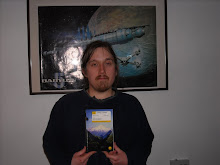
I've recently read The Writer's Journey by Christopher Vogler. I say recently but it was actually last year!
I read this book for university. Its one of three books that I'm using for a scriptwriting essay. It is a book to help writers in the creation of their stories. There are two main sections to the book, Character Archetypes and Stages of the Hero's Journey.
Character Archetypes describes well known character types that we all would recognise. To give one example we have the archetype of the mentor. Obi-wan Kenobi, in the original Star Wars, is the quintessential mentor. He is the person who guides the hero on their adventure. The other archetypes are ones we would all easily recognise from out own favourite works of fiction. However these are not set in stone. Different mentors will have different mentalities and approach their mentioning in different ways. This is the most important thing to understand when reading this book. Vogler is giving us the building blocks. If the archetypes were followed to the letter it would result in a very boring and unimaginative film.
The hero's journey is also something most of us would recognise. The hero is introduced in their normal life, called the ordinary world, and at some point they embark on an adventure into a new and different world. To use Star Wars again this happens to Luke when he leaves with Obi-wan. Another stage on the journey is the refusal. If you know Star Wars you will know that Luke is at first hesitant to follow Obi-wan. However when his uncle and aunt are killed that refusal disappears and he sets off on an adventure. It is again emphasised here that this is not a direct formula for screen, or any other, type of writing. It is a guideline only. For instance Vogler places the refusal at the beginning of the story but this may come later or not at all. It The Princess Bride Westly is completely unwavering in his pursue of Buttercup and only has a refusal near the end of the film.
I recommend this book to any aspiring writer. The book skilfully shows how to build up a story and uses popular culture references so it is easy to see in a practical way. It also shows that this is not an exact formula and can be rearranged. This is something that I think films desperately need. I've seen so many films that follow the precise structure. The one where two people fall in love and it all seems so perfect and then one of them puts their foot in it. They say something stupid and it seems the couple won't get back together. It even happens in Shrek - when hallelujah plays. That's not to say this formula can't work, Shrek is brilliant, but I think it is over used.
Wednesday, 8 February 2012

Thursday, 26 January 2012
Messy Humans!
Reports of my death have been greatly exasperated...
I know its a clichéd way to open a blog post after having been absent for so long. Since my last post I've been very busy. There was Christmas of course but the main thing I wanted to talk about was work.
Yes I have a job now. I finally have money coming in and face that horrible irony. You could call it Heisenberg's social calender. For going out with friends you need money and time. Before I didn't have the money - now I don't have the time!
In all seriousness it is good to have a job. I'm working at a shop in the restaurant. The job is varied between dull and hectic - I imagine that sort of dichotomy is the same for any job. One thing I've learned from this job is that people are very messy. The restaurant is supposed to be self clean but many people don't clear their tables. Sometimes they even put the sign that says 'Please clear your table.' on the tray! We get a lot of people coming with children. It makes me worry for the next generation as some people can't follow so simple an instruction as that!
The job pays the bills though and I'm able to fit in Uni work and other writing around it. I've hit a bit of a snag with my novels but I think I've come up with a way to plan and work on them better - writing a script.
I find that scriptwriting is easier than novel writing. So I plan to write a script to tell the main points of the story and then write the novel from that script. I've never been one to plan my work but I think that using a script as a plan could be a great help.
I know its a clichéd way to open a blog post after having been absent for so long. Since my last post I've been very busy. There was Christmas of course but the main thing I wanted to talk about was work.
Yes I have a job now. I finally have money coming in and face that horrible irony. You could call it Heisenberg's social calender. For going out with friends you need money and time. Before I didn't have the money - now I don't have the time!
In all seriousness it is good to have a job. I'm working at a shop in the restaurant. The job is varied between dull and hectic - I imagine that sort of dichotomy is the same for any job. One thing I've learned from this job is that people are very messy. The restaurant is supposed to be self clean but many people don't clear their tables. Sometimes they even put the sign that says 'Please clear your table.' on the tray! We get a lot of people coming with children. It makes me worry for the next generation as some people can't follow so simple an instruction as that!
The job pays the bills though and I'm able to fit in Uni work and other writing around it. I've hit a bit of a snag with my novels but I think I've come up with a way to plan and work on them better - writing a script.
I find that scriptwriting is easier than novel writing. So I plan to write a script to tell the main points of the story and then write the novel from that script. I've never been one to plan my work but I think that using a script as a plan could be a great help.
Wednesday, 30 November 2011
Writer's Blog: Christmas Lights
Have you ever seen the Christmas lights be turned on? I went last week and it is a strange thing. Before the lights were turned on there was the usual Christmas music but they seemed to only be playing the same six songs over and over again. I can't really blame them for that though. Often Christmas songs, or ones released around this time of year, have little to do with the season. When you take out the supremely annoying ones it doesn't leave you with many options. Having said that, they did play Rockin' Around the Christmas Tree - though that at least has the good grace to admit it's corny! So after this it came time for the lights to be turned on.
A celebrity who I'd never heard of was there to do the honours. From what I can tell this woman is so obscure she doesn't even have a page on wikipedia. Then while she was there giving her pre-turning-the-lights-on speech I couldn't help but notice one thing... Around her were many Christmas lights! Yes it seemed that someone hadn't got the memo.
...
I kid, well sort of. Pressing the button did turn some lights on and was the signal for the fireworks to begin but there were most certainly lights on before that. Is this a phenomenon present only in Britain?
A celebrity who I'd never heard of was there to do the honours. From what I can tell this woman is so obscure she doesn't even have a page on wikipedia. Then while she was there giving her pre-turning-the-lights-on speech I couldn't help but notice one thing... Around her were many Christmas lights! Yes it seemed that someone hadn't got the memo.
...
I kid, well sort of. Pressing the button did turn some lights on and was the signal for the fireworks to begin but there were most certainly lights on before that. Is this a phenomenon present only in Britain?
Tuesday, 22 November 2011
Writer's Blog: Notes from a (small) Dwarf
I don't think I'm mentioned that I have a new web site: https://unstableorbit.wordpress.com/ I have been doing a lot on that site recently which is why there hasn't been much here. So I'm going to look at two books I've read since my last post...
Notes from a Small Island by Bill Bryson and Maybe the Moon by Armistead Maupin
Notes from a Small Island is a departure from the books I normally read as it is non-fiction. I read a few excepts from this book at university and so wanted to read more. I can't recommend this book enough it is brilliant.
The small island of the title is Britain. Bryson chronicles his travels around this island and reflects on many different cities. (I will admit to being a bit miffed at him missing Cardiff.) He has a wonderful wit and a great sense of humour. He is interested in obscure facts about people and places and generally has a high opinion of Britain. Particularly, as he is American, he reflects on the differences between the two countries.
'Just the day before at Skipton I had asked for a single to Manchester with a receipt. When the man in the window passed them to me he said: 'The ticket's free...but it's £18.50 for the receipt.' If he had done that in America, the customer would have said: 'What? What're ya saying? The ticket's free, but the receipt costs £18.50? What kind of cockammamy set up is this?' (P228)
This reminds me of something that happened to my father many years ago. I must have been, I don't know, twelve at the oldest. We were going to a museum or adventure park, somewhere where you had to pay to get in, and the leaflet had prices for adults and children. Since my brother and I were of an age where this was uncertain, at some places an 'adult' is twelve years old, my father phoned them. He asked the question 'How old are children?' and received the response 'Depends when they're born.'
My father has a great sense of humour so he appreciated this joke. It got me thinking though that for some people that joke could have caused offence. I have recently been working in a customer service role. It is interesting interacting with people. Sometimes jokes occurred to me but I wasn't ever sure of when the right moment was. It must be a great skill to be able to evaluate if a joke will be taken well. Jokes can so easily backfire. Either the joke is seen as somehow offensive, the other person doesn't get it, or they simply feel that now is not the proper time for humour.
To go back to the book this was a very good read. I look forward to reading more of Bill Bryson's works.
Maybe the Moon is a very different story. It is the tale of a dwarf actor. This character, Cadence Roth, stared in a film called Mr Woods in which she played the title character. However since the role required her to wear a rubber suit and she was uncredited she is not known for this.
The story is told in the form of a journal. Cadence believes that her life is of great interest and would make an excellent film. This is a strange story but I enjoyed it. The voice of the character is engaging and the story is compelling.
As a writer I find this to be a particularly interesting tale. If one looks closely not a lot happens in the story. I do not mean this as a criticism rather it is interesting the way a novel can form from a few simple events.
I recommend both of these books and hope that you enjoy them too.
Notes from a Small Island by Bill Bryson and Maybe the Moon by Armistead Maupin
Notes from a Small Island is a departure from the books I normally read as it is non-fiction. I read a few excepts from this book at university and so wanted to read more. I can't recommend this book enough it is brilliant.
The small island of the title is Britain. Bryson chronicles his travels around this island and reflects on many different cities. (I will admit to being a bit miffed at him missing Cardiff.) He has a wonderful wit and a great sense of humour. He is interested in obscure facts about people and places and generally has a high opinion of Britain. Particularly, as he is American, he reflects on the differences between the two countries.
'Just the day before at Skipton I had asked for a single to Manchester with a receipt. When the man in the window passed them to me he said: 'The ticket's free...but it's £18.50 for the receipt.' If he had done that in America, the customer would have said: 'What? What're ya saying? The ticket's free, but the receipt costs £18.50? What kind of cockammamy set up is this?' (P228)
This reminds me of something that happened to my father many years ago. I must have been, I don't know, twelve at the oldest. We were going to a museum or adventure park, somewhere where you had to pay to get in, and the leaflet had prices for adults and children. Since my brother and I were of an age where this was uncertain, at some places an 'adult' is twelve years old, my father phoned them. He asked the question 'How old are children?' and received the response 'Depends when they're born.'
My father has a great sense of humour so he appreciated this joke. It got me thinking though that for some people that joke could have caused offence. I have recently been working in a customer service role. It is interesting interacting with people. Sometimes jokes occurred to me but I wasn't ever sure of when the right moment was. It must be a great skill to be able to evaluate if a joke will be taken well. Jokes can so easily backfire. Either the joke is seen as somehow offensive, the other person doesn't get it, or they simply feel that now is not the proper time for humour.
To go back to the book this was a very good read. I look forward to reading more of Bill Bryson's works.
Maybe the Moon is a very different story. It is the tale of a dwarf actor. This character, Cadence Roth, stared in a film called Mr Woods in which she played the title character. However since the role required her to wear a rubber suit and she was uncredited she is not known for this.
The story is told in the form of a journal. Cadence believes that her life is of great interest and would make an excellent film. This is a strange story but I enjoyed it. The voice of the character is engaging and the story is compelling.
As a writer I find this to be a particularly interesting tale. If one looks closely not a lot happens in the story. I do not mean this as a criticism rather it is interesting the way a novel can form from a few simple events.
I recommend both of these books and hope that you enjoy them too.
Tuesday, 1 November 2011
Writer's Blog: Characters#2
Sorry about the extreme lateness of this post. Its been sitting on a tab in my browser for a long time. I thought I'd posted it - turns out I hadn't.
Chapter 5 of Writing a Novel looks to the subject of characters.
Characters are one of the most complex aspects of writing. Some authors describe how they can 'watch' their characters. Basically they know the characters so well that writing a scene about them is similar to the experience of listening to a conversation and just recording what is being said. I remember JMS saying that when writing a G'Kar scene he knew the character so well that he could just 'watch' and write what was being said.
I have not had that experience with my characters yet but it must be a magical thing. I even get into difficulties with how a character looks. For this at least you can cheat - well in a way. Sometimes I just simply search for an image of a person who looks like I want my character to look - then I just simply describe them.
Incidentally one of the best character introductions I've even seen is in Twin Peaks. Specifically the introduction of Dale Cooper. It is very simple. All he is doing is entering Twin Peaks and talking in detail about his expenses and, briefly, trees. Yet in that short piece, where he is speaking into a Dictaphone, we learn all we need to know about the character.
As with the other chapters this section gives a list of exercises to try. When writing science fiction or fantasy these sorts of exercises are quite complicated. If a character is living in a fictional world then, sometimes, everything about their life has to be invented. If they visited Mars you have to think of a good name for a city on Mars.
In the novels I have read the development of character is almost invisible. You reach the end of the novel and you know many details about the character but you can't always say how you know those things.
Chapter 5 of Writing a Novel looks to the subject of characters.
Characters are one of the most complex aspects of writing. Some authors describe how they can 'watch' their characters. Basically they know the characters so well that writing a scene about them is similar to the experience of listening to a conversation and just recording what is being said. I remember JMS saying that when writing a G'Kar scene he knew the character so well that he could just 'watch' and write what was being said.
I have not had that experience with my characters yet but it must be a magical thing. I even get into difficulties with how a character looks. For this at least you can cheat - well in a way. Sometimes I just simply search for an image of a person who looks like I want my character to look - then I just simply describe them.
Incidentally one of the best character introductions I've even seen is in Twin Peaks. Specifically the introduction of Dale Cooper. It is very simple. All he is doing is entering Twin Peaks and talking in detail about his expenses and, briefly, trees. Yet in that short piece, where he is speaking into a Dictaphone, we learn all we need to know about the character.
As with the other chapters this section gives a list of exercises to try. When writing science fiction or fantasy these sorts of exercises are quite complicated. If a character is living in a fictional world then, sometimes, everything about their life has to be invented. If they visited Mars you have to think of a good name for a city on Mars.
In the novels I have read the development of character is almost invisible. You reach the end of the novel and you know many details about the character but you can't always say how you know those things.
Saturday, 29 October 2011
Writer's Blog: Graduating to Trolleys

My dad had the rather strange idea the other day. He suggested that I should wear a graduation robe to my pushing-trolleys job. It would be impractical but, as dad said, it would probably raise headlines. The point of this exercise was to highlight the
The point, that in a rambling and meandering way, I'm trying to make is simple. When a person is using the job centre their qualifications should be at the core of how they are helped. So a person with no qualifications should be given a different list of job placements to someone with qualifications.
To undermine everything I've just said the job isn't all bad. In fact were a vacancy available I would happily except it. It would give me an income, enough to pay the bills, and allow me to concentrate on my studies. Also being on one's feet and walking for so long is a great way to lose weight.
So I will be sticking with the job for the time being.
Thursday, 27 October 2011
Writer's Blog: It Has Been a Long Time
I am now back online after quite sometime without Internet. Its funny how quickly the Internet has become so much of a necessity. When I first used the net there was only one computer in our house - my parents, brother and I all had to share. Now, between the four of us, we have at least twelve Internet capable devices. I was saying to my father the other day that I could, almost, manage better missing an arm than without the Internet. - I don't want to test that theory!
With my work placement still going on posts will be a little sporadic - till the placement ends or I get used to the routine - but I should be posting at least twice a week.
I also have a new site up - https://unstableorbit.wordpress.com/. On this site, which was created as part of my university course, I hope to put longer pieces of work.
I'll be back with another post in a few days.
With my work placement still going on posts will be a little sporadic - till the placement ends or I get used to the routine - but I should be posting at least twice a week.
I also have a new site up - https://unstableorbit.wordpress.com/. On this site, which was created as part of my university course, I hope to put longer pieces of work.
I'll be back with another post in a few days.
Subscribe to:
Posts (Atom)